Dear Friend,
With the holiday season fast approaching, we’re soon to be surrounded by family, matching pajamas, and “perfect” sibling moments on social media.
But let’s be honest—what’s really often happening is the bickering, tattling, grabbing, and “that’s not fair!” soundtrack of family life with multiple kids.
When I was a teacher, I used to remind students that conflict isn’t bad—it’s an opportunity to learn relationship skills.
Now, as a parent, I find myself needing that reminder daily.
Here’s what I’ve learned: sibling rivalry isn’t a sign that something’s wrong—it’s a sign that our children are learning how to share space, power, and love.
Why Sibling Conflict Happens
Dr. Becky Kennedy (Good Inside) reminds us that kids’ behavior is communication. When siblings fight, they’re not “bad”—they’re struggling to manage big feelings like jealousy, frustration, or competition for connection.
As the book Siblings Without Rivalry explains, children aren’t really fighting over toys or turns—they’re fighting for your attention, your approval, and a sense of belonging.
And as David Thomas and Sissy Goff often say, “All kids want to know: Am I seen? Am I safe? Am I loved?”
A Parent’s Role: Stay the Anchor
When emotions run high, our job is not to referee—it’s to regulate. We’ve been given the gift of “mirror neurons” where emotions are contagious. And this goes both ways. If we flip when our kids flip, that’s mirror neurons! But, our calm can help our kids be calm, and that’s mirror neurons, too!
Instead of rehashing who’s right or wrong, help kids name their feelings and solve problems.
Try these mindset shifts:
- Instead of “Who started it?” say: “I see two kids who are having a hard time.”
- Instead of “Say you’re sorry,” try: “Let’s make it right—what can we do to fix this?”
- Instead of “Be nice!” say: “You’re both important in this family. How can we take care of each other right now?”
Conversation Starters by Age
Ages 4–7: Learning to Share Space
Focus on naming emotions and practicing taking turns.
Teach: “It’s okay to be mad. It’s not okay to hurt.”
Use picture books and playtime to practice waiting, asking, and apologizing.
Try reading together:
- Hands Are Not for Hitting by Martine Agassi
- I Am a Big Brother/I Am A Big Sister by Caroline Jayne Church
Ages 8–12: Growing Empathy and Problem-Solving
This is the “fairness” stage—when kids start keeping score.
Focus on teaching perspective-taking: “What do you think your brother wanted when he grabbed that?”
Model collaborative problem-solving instead of enforcing strict equality.
Try putting a twist on favorite family games to make them collaborative:
Ages 13–17: Respect, Space, and Repair
Older kids need privacy and autonomy—but they also need reminders that connection matters.
Help them see that respect means both boundaries and repair.
Talk about real-life relationship skills: tone, timing, and trust.
- What kind of person do you want to be when you have a conflict with someone? Practice that with your sibling.
- What do you need to do to make it right? What do they need to do to make it right? Any conflict has 2 parties. What is your slice of the pie?
Final Thought
When parents model calm, curiosity, and compassion, we teach kids what healthy relationships look like.
We can’t stop all the fighting—but we can transform it into practice for empathy, repair, and lifelong connection.
With you in it,
Peyten
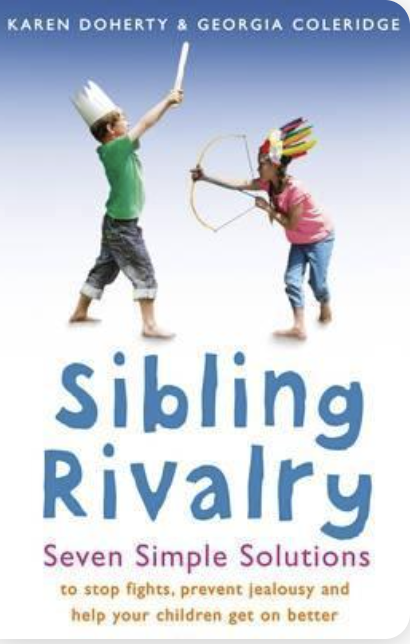
Bowbend Recommends: Sibling Rivalry: Seven Simple Solutions
I loved reading this book: Sibling Rivalry: Seven Simple Solutions. It really helped me think about how to respond to my 3 kids’ arguments.
Don’t have time to read it? Check out this 30 minute youtube book talk on this exact book!
| Coaching with Peyten |
| Got a stack of great parenting books sitting on your bedside table? No time to read them? Sometimes it’s better to talk to someone. Someone whose job it is to read those books. Whose job is to filter through all the details and parenting fads. Someone to give you just what you need. Right when you need it. Explore Coaching today to get personalized inspiration and support, and know that you’re fully empowered to do the most important job of your life. |
Leave a Reply