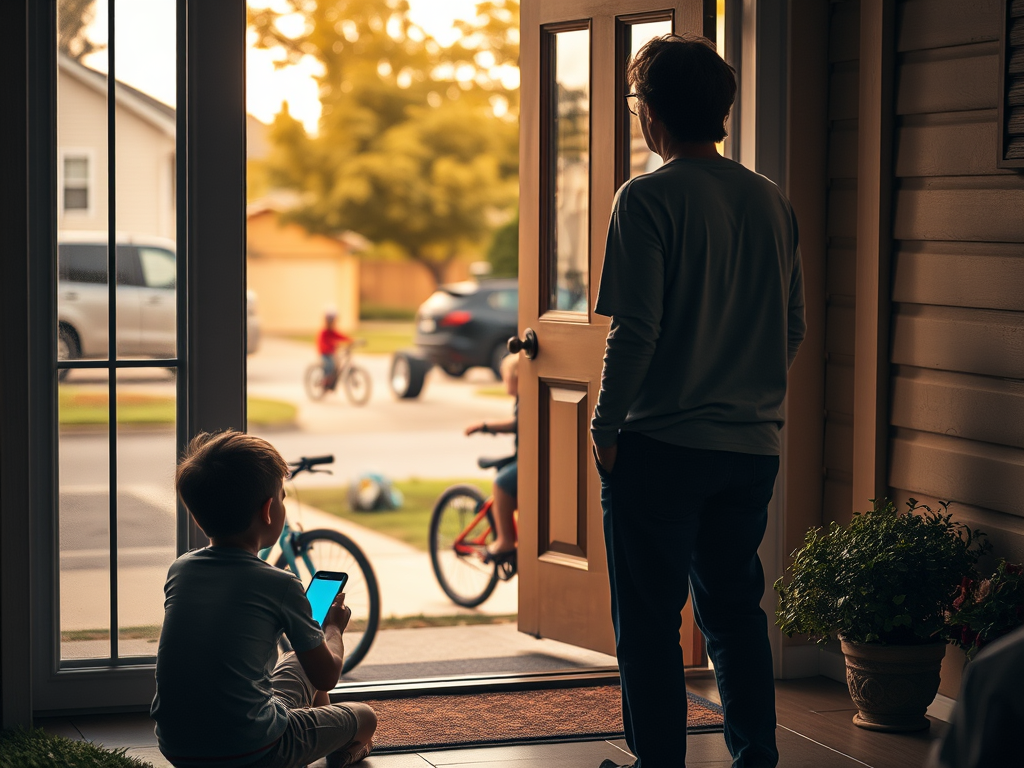
Dinner & Discussion • August 2025
A few nights ago, a group of parents gathered around my dining room table for our quarterly Dinner & Discussion. We laughed, we reminisced, and we passed bowls and bottles as we dug into a topic every modern parent feels tugged between:
How do we raise free-range kids in a world where we can track their location… forever?
And what does healthy freedom look like in an age of smartphones, AI deepfakes, and endless online noise?
Just acknowledging the tension felt like a collective exhale. Because everyone feels it—this tightrope between supervision and surveillance, between wanting our kids to become independent thinkers and wanting them to stay safe in a digital landscape that did not exist when we were young.
This is our new parenting frontier. And it’s complicated.
Below are the themes we explored, the questions we wrestled with, and the guidelines we’re beginning to shape—together.
The Four Stages of Parenting—Now With an Online Twist
We began with a framework from Andy and Sandra Stanley:
- 0–5: The Discipline Years
- 6–12: The Teaching Years (the “why behind the what”)
- 13–18: The Coaching Years
- 18+: Friendship
When we layered technology on top of this model, the discussion got real.
What does discipline look like online for a four-year-old clicking around on YouTube?
What does teaching look like when the “why behind the what” involves explaining dopamine, algorithms, and deepfakes?
What does coaching look like when your teenager has 20 group chats buzzing at 11 PM?
What does friendship look like with an adult child when you still have their location enabled?
The only thing everyone agreed on:
Parenting in 2025 requires more discernment than any generation before us.
Intrinsic Motivation: Can We Trust Kids to Choose Well?
Much of our conversation centered on the 6–12 window—the “why behind the what” years.
The question we kept circling:
Can we trust kids to do the right thing without constant monitoring?
We talked about using agreements instead of carrots and sticks, building the habit of asking before watching, and creating clear family device expectations where the goal is growth, not control.
But one parent named the elephant in the room:
“We can easily list the cons of giving more freedom. What are the pros?”
That question landed with a thud of honesty.
Because granting freedom is inherently risky, and we feel the risk more deeply than our own parents did. They assumed safety; we assume danger.
And yet—children can’t develop discernment in a vacuum. They need graduated freedom, with thoughtful scaffolding, to grow.
When We Were Kids…
We opened dinner by sharing our first memories of being alone as children.
Most of us said 5–7 years old.
We talked about bikes as freedom, knocking on neighbors’ doors, exploring the woods, walking to construction sites, and roaming small neighborhoods for hours with no check-ins, no phones, no digital breadcrumb trail.
Our parents had no idea where we were.
And no one thought that was strange.
Today, that would feel negligent.
Why?
Because we now see every possible danger, every worst-case scenario, every tragic headline from across the world.
The cultural narrative has shifted from presuming safety to presuming danger.
And we are parenting in that shift.
Are We Overprotecting in Real Life and Underprotecting Online?
This line became a through-thread of the whole night.
In real life, most of us hover.
We track.
We supervise.
We don’t let our kids ride bikes without helmets and near-constant adult oversight.
But online?
Even the most vigilant parents shared things that surprised them:
- Kids sneaking devices at 11 PM
- 3-second dopamine-drip videos making it hard to focus
- Group chats that never end
- YouTube spirals
- AI-generated images and voices that can’t be distinguished from real life
- Children who don’t have phones at home but have full access at a friend’s house
- “Weakest link” households where boundaries dissolve
One parent shared about a girl sneaking her brother’s phone from 11 PM until 4 AM and falling asleep at school.
Another said, “I trust my kid not to meet strangers. What I don’t trust is the impact of fast switching, short-form content on her brain.”
We all nodded.
Because we are 40, didn’t grow up with this, and even we struggle to put our phones down.
The New “Boogeymen”: Online Danger Through a 2025 Lens
Our list of online concerns painted a sobering picture:
- Mean friends or harmful group chats
- Pornography
- Grooming
- Violence and disturbing news
- Inappropriate content disguised as kid-friendly
- Blackmail and extortion
- Deepfake videos and photos
- AI-generated “nudes” made from a child’s regular photo
- The inability to ever “end” a playdate
- The addictive design of feeds, notifications, and constant stimulation
- The erosion of boredom tolerance
We realized that the digital world is not only unsafe—it is relentless.
The dangers do not end when the carpool door slides shut.
The Distracted Parent Problem
One of the most honest moments of the night was when someone said:
“It’s not just kids who can’t separate from screens. It’s us.”
We are physically present but mentally absent.
We scroll while they swim.
We read emails while they talk.
We check location pings while they tell a story.
If we want kids who can detach, we have to model it.
And it is hard.
Our brains also crave the easy dopamine.
We also lose hours to scrolling.
We also resist boredom.
This was a good moment of collective humility.
Practical Strategies That Emerged
Here are some guidelines we began shaping—none perfect, but all helpful:
1. Bedrooms are sacred. No screens.
Not because we don’t trust them, but because no child can self-regulate at midnight.
2. Ask permission before watching anything.
Even older kids.
“Is it okay if I watch this?” becomes a habit of discernment.
3. Big screens > personal devices.
Especially for YouTube. If a child is watching something, do it on the main screen where anyone can watch with them. And overhear when things start to devolve.
4. Set Do Not Disturb from 10 PM–6 AM.
Normalize rest.
Normalize downtime.
5. Create a family device and gaming contract.
Not rules imposed on kids—agreements created with them.
(Want a sample? Connect with me here and I’ll share our family’s contract! Or I can come to your school to facilitate a workshop where parents and students make their contracts together. No fights, just fun and agreements!)
6. Teach kids to trust their gut.
If something feels off, it is off.
7. Talk early—and often—about online safety.
Especially with “rule-followy” kids who might be overly trusting.
8. Explain the why behind every boundary.
Connection → understanding → cooperation.
9. Build trust through conversation, not surveillance.
Monitoring is not the same as mentoring.
10. Maintain family location sharing, but reconsider friend location sharing.
The social dynamics can get messy. At least talk about it with kids before they share or follow.
11. Name the real dangers out loud.
Especially AI deepfakes, impersonation, and synthetic images.
12. Give graduated freedom offline too.
Independence requires practice, not perfection.
The Tension of Tracking: When Do We Stop?
This question sparked a long discussion.
Do we stop tracking at:
- High school?
- College move-in day?
- At age 18?
- When they ask?
- Never?
There was no consensus.
But we acknowledged the friction kids feel:
“I have good judgment. Why don’t my parents trust me?”
Tracking can feel like love to us and suspicion to them.
This requires wisdom—and likely case-by-case decisions.
We Want Discernment More Than Obedience
Ultimately, the heart of our conversation came down to this:
Our kids need discernment—not just compliance.
They need to know:
- How to evaluate content
- How to spot manipulation
- How to know what is real
- How to know when something is fake
- How to ask for help
- How to recover from mistakes
- How to protect themselves and others
- How to think for themselves
And they need these skills in both the real world and the digital one.
That requires trust—ours in them, and theirs in us.
Closing Thoughts
Raising children in 2025 requires wisdom, courage, humility, and a sense of humor.
We are navigating a world our parents never imagined—and our kids don’t know anything different.
There is no perfect approach, only thoughtful, evolving ones.
What matters most is that we stay connected.
That we talk often.
That we explain our why.
That we give freedom in measured doses.
That we model healthy tech habits ourselves.
And that we remember:
Our goal isn’t to protect our children from every danger.
It is to prepare them to navigate a world where discernment is their greatest asset and they know we trust them. Because they are trustworthy.
Here’s to raising kids who are wise, brave, grounded, and digitally resilient.
And here’s to parents who are doing their best in a rapidly changing world.
You are doing holy work.
And you’re not doing it alone.
Leave a Reply